

by Rev. Dr. Shannon Smythe, with an introduction by Deanna Roberts, MDiv, MILS
Introduction
When people think of Christian Zionism it is assumed that those with this belief come from a conservative charismatic or Evangelical tradition. However, over the past two years the veil has been removed from liberal Christian spaces. At the best, many of these liberal Christian Zionist churches have been reluctant to acknowledge or address the harm being done. And at the worst, they have been fully complicit in the destruction of Palestinian life. Christian Zionism is not, and has never been, relegated only to fundamental right-wing corners of US Christianity. Christian Zionism—the foreign policy extension of white Christian Nationalism—permeates into every layer of our society.
Christian Zionism teaches that the secular State of Israel is a fulfillment of biblical prophecy. William Blackstone, a Chicago evangelist, published Jesus Is Coming in 1878, a best-selling book that sold many Americans on the idea that to hasten the return of the Messiah, a new Jewish state was needed. Christian Zionist theological beliefs fall on a spectrum. On one side there is the dispensationalist view that emphasizes a literal interpretation of scripture and an earthly kingdom for Israel so that when the Messiah returns, in the last days of judgment, the Jews will have a chance to convert to Christianity or be condemned to the fires of Hell. On the other side is the position supported by mainline Protestants who backed Israel’s creation, and continued existence, for “humanitarian/progressive” reasons as a safe haven for Jews, seeing it as aligning with social justice. Palestinian liberation theologian Rev. Dr. Mitri Raheb writes in his book Decolonizing Palestine: The Land, The People, The Bible that Christian Zionism is “a Christian lobby that supports the Jewish settler colonialism of Palestinian land by using biblical/theological constructs within a metanarrative while taking glocal considerations into account.” Christian Zionism manufactures consent for the many illegal actions of Israel. Not only is Christian Zionism incredibly harmful to our Palestinian siblings—Christian and Muslim—it is also harmful to our Jewish siblings. The late Marc Ellis, a Jewish liberation theologian, explained this unyielding Christian support for Israel as the “Ecumenical Deal.” A pact made between western Christians and Jews that sells out the human and civil rights of the Palestinian people in order to absolve ourselves (white Christian westerners) of the guilt from the Nazi Holocaust, Christian Zionism is a perversion of the stories in scripture that recount the life and ministry of Jesus.
Liturgically speaking, the season of Advent is meant to be spent waiting and preparing for the arrival of Jesus, a Palestinian Jew born under the Roman occupation of Palestine. What better way to prepare for the arrival of the Christ child than to align yourself with the prophetic tradition of Palestinians who have been calling on US Christians to combat Christian Zionist theology since the first Kairos Palestine document of 2009? What better way to bring in the season of Christmas than by centering the experiences of the living stones of Palestine?
This story from Rev. Dr. Shannon Smythe is just one of many examples found within liberal Christian spaces that boast a robust, fully inclusive, progressive, and liberatory theology when in reality they are progressive—albeit performatively—but not when it comes to Palestine. This category of Christian is commonly referred to as one that is “progressive except for Palestine.” Many Christians have chosen to remain silent for fear of being called “antisemitic”—a term that has been weaponized to equate any criticism of the State of Israel with anti-Jewish hatred. As Rev. Dr. Donald Wagner said in his interview for the ISCZ podcast, Bad Theology: Busted, “These days are over. It’s time for us to name this and be more aggressive in it.” Real solidarity costs something. In silencing this prophetic voice speaking on Palestine, this branch on the mainline liberal US Christian church tree has signaled that it is more important to them to maintain the status quo rather than meet the urgency of this moment with true solidarity. A solidarity which is in full alignment with Presbyterian Church (USA) policy.
________________________________________________________________
Uninvited in Advent: Church Chooses Silence over Solidarity
I was uninvited to church this week. Yes, you heard me right.
I do a lot of pulpit supply, often preaching two to three times each month in churches without a pastor. This past week, the elders of one of those churches rejected the liturgy I submitted for the worship bulletin because it linked Advent I’s theme of hope to Rev. Munther Isaac’s sobering reminder: “If Jesus were to be born today, he would be born under the rubble in Gaza.”
In an awkward phone call on the afternoon before Thanksgiving, I was told they did not want a focus on Palestine in their Advent worship service. They asked me not to come fill their pulpit after all. Having preached there numerous times in the past year, sharing about my involvement in the nonviolent witness of Interfaith Action for Palestine in DC and the mutual aid efforts happening outside of the Delaney Hall Detention Center in Newark, NJ, I was shocked that this PC(USA) congregation—a denomination whose stance on Gaza has been articulated by the Stated Clerk of the General Assembly: “As followers of Jesus Christ, we are called to stand in the deepest places of suffering, to speak when silence enables harm, and to act wherever human worth is disregarded”—would decline to sing the new verses of O Come, O Come, Emmanuel written by Malik Ready, Jenny Bonham-Carter, Chris Wylie, and Adam Barnes. These verses cry out for justice and solidarity with lines such as: “and bring us justice here and now; we join with those exiled here, till unity and love appear.”
The Stated Clerk also urged us to pray for peace grounded in justice—justice that leads to lasting peace. She called us to seek God’s wholeness in a just peace where Palestinians, Israelis, and people of all faiths can flourish, and reminded us not to look away. Taking seriously this call and having taken up FOSNA’s Advent 2025 call to “Preach Palestine,” I adapted a beautiful Call and Response prayer written by a group of churches in Ontario praying for a just peace for Palestinians and Israelis with a refrain asking that Palestinians, Israelis, and all who dwell in that land—each made in God’s image—might know divine comfort and love. The prayer concluded: “May we, your church, created in your image, be unsettled and emboldened to act as we witness the suffering of Palestinians and Israelis. And let justice roll on like a river, righteousness like a never-failing stream.” The ruling elders rejected such a prayer from their Sunday worship service.
I’m sharing this experience because it reveals not only how deeply our churches cling to silence but also how successful the Empire has been at making US Christians forget the message of Advent and Christmas: that the incarnation is God’s ultimate act of solidarity—leaving the comfort of heaven to enter our struggle on earth, born as a vulnerable baby amid genocide.
As a PC(USA) pastor who has not shied away from naming what Rev. Dr. Martin Luther King Jr. terms the triple evils of capitalism, racism, and militarism in a multitude of white dominant PC(USA) churches I have served in, my experiences have consisted largely of some variation of being “uninvited,” whether through a letter writing campaign against me, secret Session meetings to critique my performance, or being told by the Senior pastor that telling the truth about the origins of Thanksgiving is not pastoral enough. At this point, my question to the PC(USA) is whether we really care that our “official” stances on issues like structural racism or the genocide in Gaza, to name a few, are largely not anything congregants care about or want to hear in worship.
How can we be in true Christian fellowship or communion with our Palestinian Christian siblings while so many of our churches deny, support, justify, or remain silent before genocide? Our Palestinian Christian siblings have been calling us to costly solidarity for years. What we do to the children of Gaza, we do to Christ. This Advent, I wonder how many US pastors, knowing that their congregation prefers comfort over courage and silence over solidarity, will choose the path of least resistance over a bold call to courageous resistance.
Earlier this week, the PC(USA)’s Office of Public Witness published a wonderful guide called “Holy Discontentment: Grassroots Advocacy and Organizing in the PC(USA),” which is offered “as a starting point for those ready to raise their voices, deepen their witness, and live more fully into the call to seek justice, love mercy and walk humbly with God.” But what happens when Western churches say very clearly that not only are they still not ready to raise their voices, but that they do not want to be a witness, seeking justice, loving mercy, and walking humbly with God? What kind of Advent are we preparing for when our congregations prefer a saccharine, sentimentalized and highly sanitized story over the one about a brown-skinned Palestinian Jewish baby whose life was threatened by an unjust Ruler, forcing his family to flee to another land?
—————————————–
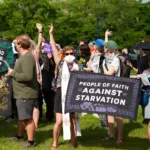 Rev. Dr. Shannon Smythe is a PC(USA) minister serving as Director of the field education program at Princeton Theological Seminary. She organizes with FOSNA and Christians for a Free Palestine and serves on the Steering Committee of the Palestine Justice Network of the PC(USA) and the Presbyterian Advisory Council of Churches for Middle East Peace.
Dee Roberts (she/they) is the Library Manager for ISCZ. A queer theological librarian, Dee is currently working as the Reference and Outreach Librarian at Pitts Theology Library, Candler School of Theology at Emory University in Atlanta. Dee is committed to combatting disinformation and misinformation as it relates to Palestine. They are the author of Libraries and Access to Information in Palestine: Impacts of Military Occupation and “Neutrality and Social Justice: A Theological Librarian’s Perspective on Academic Freedom and Responding to Injustice” in Resisting Erasure: Libraries in Palestine and Palestine in Libraries edited by Nora Lester Murad and Mary L. Onorato, forthcoming from Library Juice Press. Dee serves on the Steering Committee for the Palestine Justice Network of the PC(USA) and has been actively involved in the organization since 2014.