

By Tariq Kenney-Shawa
 After nearly three years of genocide in Gaza and endless wars across the region, many of Israel’s supporters are now lamenting the country’s rapid descent into international isolation. As Israel’s popularity plummets, they warn that it cannot afford to lose the Western allies and benefactors whose support has long rested, at least rhetorically, on the fiction that Israel is a liberal democracy defending shared values. Yet while the cacophony of admonitions and pleas for restraint from Israel’s liberal allies intensifies, Israeli Prime Minister Benjamin Netanyahu and his far-right coalition appear far less alarmed. If anything, they increasingly seem to view isolation not as a catastrophe to avert, but as a strategic reality to exploit.
In September 2025, Netanyahu publicly acknowledged that Israel was entering “a sort of isolation” and would need to develop an economy with “autarkic characteristics.” Israel, he said, would have to become “super-Sparta,” capable of waging its genocidal wars of expansion without relying on the impunity granted by benefactors answerable to the democratic will of their populations that are turning on Israel. His response to Israel’s growing pariah status was, of course, not to end the genocide, lift the occupation, or even mildly restrain Israel’s expansionist ambitions. It was to double down: make Israel more militarized and less vulnerable to whatever pressure the outside world might eventually muster.
Over the coming years, Israel’s “super-Sparta” strategy will increasingly focus on cultivating an emerging illiberal international—a global, impunity-based support system of Christian Zionists, far-right movements, and authoritarian regimes that have little need to invoke the fiction of Israel as a liberal democracy to justify their complicity in its war crimes and human rights violations.
That does not mean Israel has given up on winning back Western public opinion. Its 2026 budget earmarks roughly $730 million for disinformation campaigns and propaganda, or hasbara, nearly five times the $150 million allocated the previous year—which was itself around twenty times Israel’s typical spending before the genocide. However, Israel’s efforts to salvage its legitimacy among Western audiences are increasingly being eclipsed by the steps it is taking to limit the consequences of their continued opposition.
But of course, it is critical not to overstate Israel’s international isolation. The United States continues to arm the Israeli military to the hilt and shield it diplomatically from the political and material consequences of its genocide. European governments maintain deep trade and security relationships while punting demands for meaningful sanctions to a day that never seems to arrive. The European Union was still Israel’s largest trading partner in 2025, accounting for nearly a third of its trade in goods. Meanwhile, normalization with Arab regimes has survived the destruction of Gaza and Israel’s expanding occupations of Lebanon and Syria.
The deeper problem for Israel is that the liberal mythology long used to legitimize these relationships is collapsing underneath it. For decades, Israel sold itself as a democratic outpost defending Western values in a hostile region—a claim always irreconcilable with the oppression of Palestinians and decades of military rule, but one Western governments were nevertheless willing to promote. Gaza has made that contradiction impossible to hide from the publics those governments supposedly answer to.
Across 36 countries surveyed by Pew this year, a median of 67% held an unfavorable view of Israel. That included 78% in Spain and Sweden, 75% in Italy, and 73% in Germany. In the United States, unfavorable views reached 60%, up from 42% in 2022. Among Americans aged 18 to 34, the figure was 74%.
Governments have proven capable of ignoring public opinion for a long time, particularly where Israel is concerned. But elections, protests, unions, universities, pension funds, courts, and civil society can eventually translate moral revulsion into real policy changes: restrictions on weapons, trade, and diplomatic protection. That possibility is what makes constituencies comparatively insulated from those pressures increasingly valuable for Israel.
Christian Zionists are perhaps the clearest example. While Liberal Zionists once defended Israel because they believed it shared their values, Christian Zionists defend Israel because they believe it fulfills biblical prophecy. That theocratic-based allegiance has long blinded Christian Zionists to Israel’s crimes. Even as support for Israel collapses elsewhere, white evangelical Protestants remain among its strongest constituencies in the US with 65% holding a favorable view of Israel.
Yet even this alliance is beginning to fray along generational lines. A Marquette University Law School survey found that while 70% of US evangelicals over 60 approved of Israel, only 39% of those between 18 and 29 did. Israel has noticed. Last December, more than 1,000 American pastors travelled to Israel for what organizers called the largest evangelical delegation in the country’s history. The urgency is revealing. Israel is investing so heavily in Christian Zionism because a constituency whose allegiance is tied not to shared liberal values, but to blind scripture becomes more valuable as unconditional support elsewhere grows increasingly scarce.
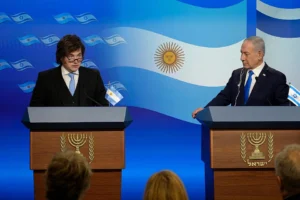
Israel’s embrace of the global far right follows much the same logic. Netanyahu spent years cultivating Israel’s relationship with Viktor Orbán in Hungary, Javier Milei in Argentina, and nationalist and anti-immigration movements across Europe. Israeli diplomats have established close ties with France’s National Rally, Spain’s Vox, and the Sweden Democrats—parties that have deep roots in Europe’s fascist and antisemitic right.
These alliances offer something to both sides. Far-right parties with antisemitic histories can embrace the Israeli state, redirect domestic racism toward Muslims and migrants, and present themselves as defenders of “Judeo-Christian civilization.” Israel, in turn, acquires allies willing to attack international courts, obstruct sanctions, demonize Palestine solidarity, and recast Israeli violence as one front in a civilizational war against Islam, migration, and the “left.”
That convergence is spreading well beyond Europe. Latin America’s rightward pendulum swing has already produced a string of governments eager to deepen relations with Israel. Argentina’s Milei has visited Israel repeatedly and called himself the “most Zionist President in the world.” New right-wing governments in Bolivia and Chile restored or upgraded relations that had been severed under their left-wing predecessors. And within days of taking office this summer, Colombia’s new far-right president, Abelardo de la Espriella, restored diplomatic relations with Israel, pledged to move Colombia’s embassy to Jerusalem, became the only country apart from the US to recognize Israeli sovereignty over the occupied Golan Heights, and began withdrawing Colombia’s support for South Africa’s genocide case at the ICJ. Meanwhile, Venezuela’s interim President Delcy Rodriguez has restored diplomatic ties with Israel after Caracas cut them in 2009 in response to Israel’s 2008 assault on Gaza
The appeal is partly ideological and partly transactional. Evangelical Christianity has helped bind much of the Latin American right to Israel. But alignment with Israel has also proven to be an effective way for governments seeking weapons, intelligence cooperation, or favor in Washington to demonstrate their usefulness to a US administration that treats support for Israel as a loyalty test.
India under Narendra Modi occupies a similar space. Hindutva and Zionism have developed an increasingly open ideological affinity around ethnonationalism, Islamophobia, and the politics of permanent security threat, reinforced by extensive military and technological cooperation. India was the single largest buyer of Israeli major arms between 2020 and 2024, accounting for 34% of Israel’s weapons exports.
Then there are governments whose relationships with Israel are even less encumbered by public opinion. The Abraham Accords offered a particularly stark demonstration that Israel can build deep relations with Arab rulers without winning the consent of Arab societies. The 2025 Arab Opinion Index found that 87% of respondents opposed their countries recognizing Israel; just 6% supported recognition.
Those numbers have constrained some governments – Saudi Arabia, for instance, has been forced to make Palestinian statehood a public condition for normalization – but they have not eliminated security cooperation. Leaked US documents reported last year showed that several Arab governments quietly expanded military cooperation with Israel during the Gaza war even as they publicly condemned its conduct. For authoritarian rulers, the calculation is brutally straightforward: Israeli weapons, surveillance, intelligence, and access to Washington outweigh the political preferences of populations that have little meaningful ability to change foreign policy at the ballot box.
None of this is merely Netanyahu’s personal project. Rather, it is a reflection of a society born in ethnic cleansing and sustained on occupation and genocide. A 2025 survey found that 82% of Jewish Israelis supported the forced expulsion of Palestinians from Gaza and 56% supported expelling Palestinian citizens of Israel. Nearly half agreed with a question asking whether the Israeli military, after conquering an enemy city, should kill all of its inhabitants in the manner of the biblical conquest of Jericho.
A state increasingly fueled by a lust for annexation, demographic supremacy, and permanent war will naturally find greater affinity with movements that regard hierarchy, exclusion, and unrestrained sovereign violence as legitimate principles of rule. And Israel is finding the emerging international order increasingly accommodating. Freedom House recorded a twentieth consecutive year of declining global freedom in 2025, while V-Dem estimates that nearly three-quarters of humanity now lives under autocratic rule. Israel is not merely embracing an illiberal world; much of the world is moving in lockstep with Israel in a collective race to the bottom.
This does not mean the Palestinian liberation movement’s strategy of isolating Israel has failed. Quite the opposite. A government does not spend nearly a billion dollars on public diplomacy, scramble to expand domestic weapons production, and openly discuss preparing for sanctions because international pressure is irrelevant. Israel’s turn toward “super-Sparta” is evidence that pressure is being felt.
The danger lies in confusing reputational isolation with material isolation. Israel can lose the argument and continue receiving the weapons, capital, technology, and diplomatic protection necessary to wage permanent war from allies in which that argument doesn’t matter. That is why the task is not simply to make Israel unpopular, but to convert that unpopularity into pressure at the points that an illiberal international support system cannot withstand.
In a globalized world, and for such a small country, Israel’s dependencies remain deep. Indeed, Israel’s supposed march toward self-sufficiency actually looks a lot more like deeper integration with the very benefactor from which Netanyahu claims he wants independence. Formal US-Israeli negotiations launched this May over a new Memoriam of Understanding (MOU) that envisions replacing the existing US military aid package to Israel with expanded joint research, development, and weapons co-production. The House passed a 2027 National Defense Authorization Act (NDAA) that goes further, proposing to integrate the Israeli military more deeply into the US military and military industrial complex through weapons and AI development and defense manufacturing. “Super Sparta,” in other words, may mean less dependence on discretionary American aid while binding Israel more tightly into the US military itself.
Israel’s strategy is therefore not to abandon the West for some rival geopolitical camp. It is to preserve Western material support while insulating itself as much as possible from Western democratic pressure. Israel will continue spending millions to convince liberal audiences that Israel remains one of them. But where that argument fails, it will increasingly cultivate actors who never required the performance in the first place: Christian Zionists who see Israeli power as prophecy fulfilled, ethnonationalists who admire its brutality, and authoritarian rulers who value its weapons and surveillance more than the opinions of their own citizens.
That is Israel’s unfolding illiberal international. “Super-Sparta” is the wager that military integration, economic resilience, and ideological loyalty can compensate for the legitimacy Israel has destroyed. The wager may fail; Israel remains far too integrated into the very liberal order it disdains. But Palestinians and their allies cannot afford to assume that winning the moral argument will, by itself, make Israeli domination unsustainable. The next stage of the struggle will be about forcing the governments and institutions that still materially sustain Israel to finally catch up with publics that increasingly no longer do.
Tariq Kenney-Shawa is Associate Fellow at Al-Shabaka, The Palestinian Policy Network, and co-host of Al-Shabaka’s Policy Lab series.